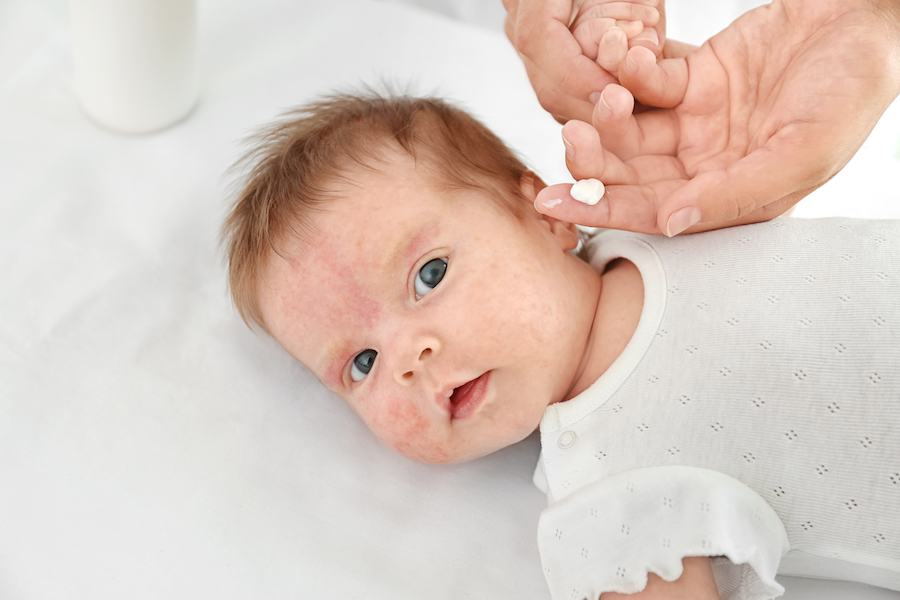
Eczema in children
What is eczema?
What causes eczema in children?
Signs and symptoms of eczema in children
Symptoms of eczema in infants
Symptoms of eczema in children
How is eczema diagnosed?
Treating eczema in children
Preventing eczema and allergies in children
What parents say:
Frequently Asked Questions
When can paediatric eczema appear?
Eczema commonly manifests on a child’s skin during the initial three months of life, particularly among those I encounter in my clinic who also have concurrent food allergies. Most children who develop eczema will do so within the first year of their life.
It’s important to note that there are certain skin conditions, such as erythema toxicum neonatorum (ETN) or neonatal acne (acne neonatorum), which can occur in the first few weeks after birth and should not be confused with eczema, as they exhibit more pustular characteristics. Additionally, there may be instances of skin dryness during infancy that are associated with a later onset of food allergies.
What are the causes of eczema development in babies and children?
Understanding the factors that contribute to the development of paediatric eczema in infants and children is crucial, and it’s a topic I regularly discuss with parents in my clinic. Several factors play a role in this condition.
Firstly, genetics are significant. Often, when I encounter a child with eczema, one of their parents has experienced hay fever at some point in their life. Hay-fever is frequently associated with eczema in children.
However, if one or both parents have eczema themselves, the risk of their child developing eczema is even higher. This is because certain proteins, such as the Filaggrin protein, play a vital role in maintaining the skin barrier. They act as the adhesive between skin cells in the outer layer, ensuring that the skin remains resilient, retains moisture, and is safeguarded against irritants and allergens.
Having a mutation in the gene responsible for Filaggrin or other skin barrier proteins leads to a deficiency of these proteins in the skin. As a consequence, individuals with such mutations often experience dry skin. This occurs because the skin becomes highly permeable, causing water loss.
Additionally, the weakened skin barrier allows various environmental factors to penetrate and irritate the skin. Examples of these irritants include wool or synthetic clothing, high temperatures, detergents, and bubble bath. Even the products used to cleanse the child can further compromise the integrity of the skin barrier. Prescribed creams for children may have a high pH, which can damage the skin barrier.
Consequently, these environmental factors contribute to the disruption of the skin barrier. In the case of children with eczema, their skin is more susceptible to colonisation by bacteria and other pathogens. This susceptibility arises from both the compromised skin barrier and the lack of certain proteins in their skin that normally combat bacteria, fungi, and viruses.
When I examine children with eczema in my clinic, I always check for any signs of itchiness, inflammation, or potential infection in the skin. This information is crucial for determining the appropriate eczema management approach for children.
Can food allergies cause eczema in children?
In addition to genetic and environmental factors, there is also a possibility that food allergies could be a factor in paediatric eczema, which can be classified as immediate food allergies (IgE-mediated), delayed food allergies non-IgE mediated) or mixed.
In children, food allergy is relatively uncommon compared to skin barrier defects or infections as the underlying causes of eczema. However, in some cases, food allergies can worsen eczema symptoms. To assess this possibility, appropriate tests can be conducted, followed by a process of food exclusion and reintroduction.
In my practice, I thoroughly review the clinical history, perform allergy testing, and evaluate the results. It is crucial to recognise that eczema itself can contribute to the development of food allergies. Therefore, effectively managing eczema is not only important for preventing flare-ups and skin infections but also for minimising the risk of developing additional allergies.
I recommend assessing children that have severe eczema for the possibility of food allergy particularly in those children who have developed eczema under three months of age. In a large study done in Australia it showed that in children who had eczema that started under three months that had required topical steroids, actually had a 50% risk of food by one year of age, so it’s important to assess.
Want to know more about Paediatric Eczema? Read the full article on Feeling comfortable in their skin: All about paediatric eczema by consultant paediatric allergist Dr Helen Brough. More information can be found on our Eczema Management page.
Do symptoms of eczema improve or disappear as a person gets older?
It is commonly observed that symptoms of paediatric eczema can improve and even disappear with age. According to published data by healthcare professionals, approximately two-thirds of children no longer experience eczema by the time they reach puberty.
In my own practice, I frequently encounter children under the age of one with eczema, but by the time they turn two, a significant improvement is often observed in most of the children I see at the clinic. At this stage, they may only require moisturisers to manage occasional dry skin.
What are the recommended practices and precautions when treating children’s eczema at home?
Effective home treatment for children’s eczema holds significant importance. By implementing the right practices, it is possible to make a substantial improvement in the child’s skin condition. Whenever I see a child in clinic, I develop a written eczema treatment plan and thoroughly discuss each stage with the parents.An essential step is to ensure that children with eczema take a daily bath. This is crucial because their skin lacks certain proteins needed to clear bacteria, viruses, and fungi. Regular bathing helps remove residues of irritants on the skin and potential sensitising factors from foods that can affect the child through their skin.
It is important to use tepid water, as hot water can irritate the skin and trigger scratching. The duration of the bath should not exceed ten to fifteen minutes, as prolonged water exposure can further irritate the skin and increase vulnerability. During daily baths, it is crucial to avoid using bubble baths, regular soaps, or detergents to wash the child.
Instead, children with eczema should use a non-soap substitute, typically in the form of a cream, for washing. This cream is applied to the child’s skin and then rinsed off with water. After the bath, it is ideal for the child to be in a room with a moderate temperature (neither too cold nor too hot), and their skin should be gently patted dry with a towel.
Following bathing, the next important aspect is the proper use of moisturising creams on affected areas. It is advisable to use clinically proven eczema products, as I only recommend those. There are various lotions, creams, and ointments available to be applied to the skin, and different children may find different options suitable for their needs.
The choice of the most suitable product can also depend on the weather conditions. In colder weather, ointments may be more appropriate as their thicker consistency helps to retain moisture, which can be beneficial for children experiencing worsened eczema symptoms during the winter. On the other hand, during summer, creams may be preferred due to their lighter texture and easier absorption into the skin.
In some cases, lotions and creams can be more irritating to the skin compared to ointments. Therefore, it is crucial to avoid using fragranced creams and instead opt for ones that contain minimal ingredients. When applying the cream to the child’s entire body, I always advise parents in my clinic to first test it on a small patch of skin to ensure it doesn’t cause any irritation before applying it more broadly.
For young children, approximately 250 grams of cream should be used per week, while older children may require around 500 grams. The cream should be applied generously, forming a thick layer that covers the child’s entire body, including the face and scalp if those areas are dry.
It is essential to moisturise the skin using smooth downward strokes, avoiding rubbing as it can irritate the hair follicles. Applying the cream in the direction of hair growth and allowing it to be absorbed into the skin is the recommended approach.
It is crucial for parents to wash their hands before applying cream to their child’s skin. Additionally, it is common to see parents dipping their hands directly into a pot of ointment to retrieve the product, inadvertently contaminating the entire container with bacteria. Since the pot is often stored at room temperature, it provides an environment conducive to bacterial growth.
Applying contaminated ointment to the child’s skin can lead to irritation. However, this can be easily avoided. It is remarkable how simple strategies can have a significant positive impact on a child’s skin condition, as well as on their overall quality of life and that of their family.
At what point should I seek medical attention for my child’s eczema?
The National Eczema Society website, a charitable organisation dedicated to supporting individuals with eczema, offers a wealth of valuable resources including best ways to treat eczema, avoiding triggers and eczema flares. Browsing through their information can provide a solid starting point to explore various strategies for improving your child’s eczema.
However, if your child’s eczema persists despite using standard moisturising creams and causes persistent itching that impacts their daily life, it is advisable to seek advice from a healthcare professional about eczema management. Prompt medical attention is crucial if your child’s eczema becomes infected, requiring urgent evaluation by a doctor.
Want to know more about how to treat children’s eczema at home? Read the full article on The do’s and don’ts of treating children’s eczema at home by consultant paediatric allergist Dr Helen Brough. More information can be found on our Eczema Management page.